
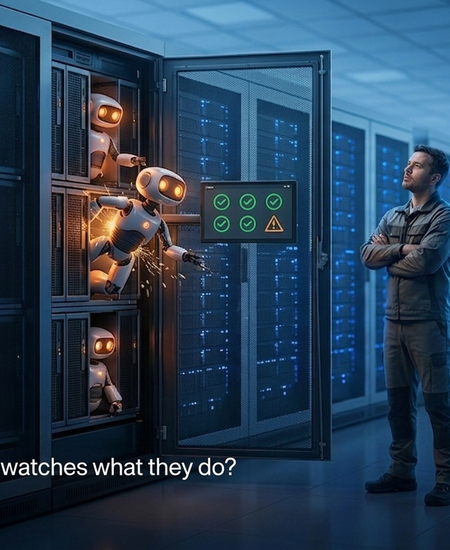
Two signals from May 2026 point to the same shift - and what comes after.
Autonomous Agents have become the new occupants in Kubernetes clusters. For years, engineering teams perfected the stateless, predictable container - wrapped in GitOps and CI/CD pipelines to ensure that what deployed yesterday runs exactly the same tomorrow. Agents break that model.
Two recent signals make this shift concrete. In May, the Agentic AI Foundation (AAIF) published a technical analysis of what Kubernetes infrastructure actually needs to support agentic workloads. And in March, CNCF announced that the number of certified Kubernetes AI platforms nearly doubled since the program launched - a 70% surge that now includes explicit validation for agentic workflows.
Together they tell one story: the infrastructure layer is catching up to agents. And for SRE and platform engineering teams, that raises a question that is only going to get more urgent.
The Problem With Predictability
Traditional Kubernetes patterns are built around Desired State. A human defines exactly how many replicas should run, what their memory limits are, and how they should communicate. Agents are inherently different. They do not just respond to traffic - they generate logic, spawn sub-tasks, and mutate their own requirements based on the complexity of the goal at hand.
As AAIF author Max Körbächer describes it: we have the right engine but the wrong blueprints. The design patterns established between 2020 and 2022 were built for microservices - stateless, predictable, version-controlled. Applying those patterns to autonomous agents creates active friction.
Source: AAIF — aaif.io/blog/agentic-ai-infrastructure-on-kubernetes
The infrastructure needs to be as agile as the agent it hosts.
The Four Pillars Agentic Infrastructure Requires
The AAIF analysis identifies four capabilities that have moved from nice-to-have to fundamental requirements:
1. Isolation and Sandboxing
An agent testing a hypothesis should operate inside a safe container boundary - not with access to the production cluster. Current infrastructure treats a crash as a failure to be mitigated. In an agentic world, an agent might intentionally spin up a temporary environment, execute a generated script, and tear it all down. The orchestrator needs to understand the difference between intentional ephemeral execution and actual failure.
2. Stateful Memory Fabrics
The AAIF article describes the move away from the "stateless sin" of early AI - where every interaction required passing massive context histories back and forth. The infrastructure must provide a tiered cognitive memory layer: hot KV-caches for active reasoning, warm shared memory for agent swarms, and cold vector-native storage. Projects like MCP are a first step, but memory needs to live in the infrastructure itself - not bloat the context window.
3. Dynamic GPU Scheduling
Workload-aware scheduling is now a hard requirement, not an optimization. This aligns directly with what CNCF codified in the Kubernetes v1.35 requirements: Stable In-Place Pod Resizing - letting inference models adjust resources without restarting - and Workload-Aware Scheduling to avoid resource deadlocks during distributed training.
4. Ephemeral Execution
Human-vetted GitOps, where every infrastructure change requires a pull request and a manual merge, has become a bottleneck for agentic systems. When an agent decides autonomously to spin up a temporary Python environment to process a dataset, the current PR-required flow is a wall. Infrastructure needs to allow controlled, auditable ephemeral execution without requiring human sign-off for every transient operation.
CNCF: Infrastructure Is Responding
The timing of CNCF's March announcement at KubeCon Europe is significant. The Kubernetes AI Conformance Program has grown from 18 to 31 certified platforms - a nearly 70% surge - and the program has expanded to explicitly validate agentic workloads.
The new v1.35 requirements are not incremental updates. They are direct responses to the architectural demands of agentic systems: stable in-place pod resizing, workload-aware scheduling, and the beginning of standards for disaggregated inference and LLM traffic routing.
CNCF CTO Chris Aniszczyk described the direction: standardizing AI infrastructure means addressing the core architectural shifts in the ecosystem, not just labeling clusters as AI-ready.
Source: CNCF — cncf.io/announcements/2026/03/24/cncf-nearly-doubles-certified-kubernetes-ai-platforms/
The 2026 roadmap extends further: automated conformance testing through a dedicated Verify Conformance Bot, and expansion toward Sovereign AI standards with enhanced sandboxing and data privacy requirements.
The Production Gap This Creates
Infrastructure catching up to agents is necessary. But it creates a new operational gap.
As agents become first-class workloads in Kubernetes clusters - spawning sub-tasks, mutating requirements, executing ephemeral operations - the question of what is happening in production becomes significantly harder to answer. Agents produce different failure modes than microservices. An agent that is confidently wrong does not look like a crash. An agent that is exploring a hypothesis does not look like normal traffic.
Traditional monitoring was built around predictable workloads. Observability for agentic systems requires understanding intent, not just state.
Telemetry collection is not the bottleneck. Investigation - understanding what an agent actually did, why, and what it caused - is where the gap lives.
This is the boundary where production intelligence becomes critical. Not just "is the pod running" but "what did the agent do, what changed, and what broke as a result."
At OpsWorker, that investigation layer is what we build. As agents become permanent residents of production clusters, the ability to automatically investigate what they cause - before an engineer opens a terminal - becomes the next reliability requirement.
OpsWorker is an AI SRE Production Intelligence platform for Kubernetes teams.
14-day free trial: app.opsworker.ai | Book a demo: calendly.com/opsworker/discover-opsworker
Subscribe to our email newsletter and unlock access to members-only content and exclusive updates.
Comments