
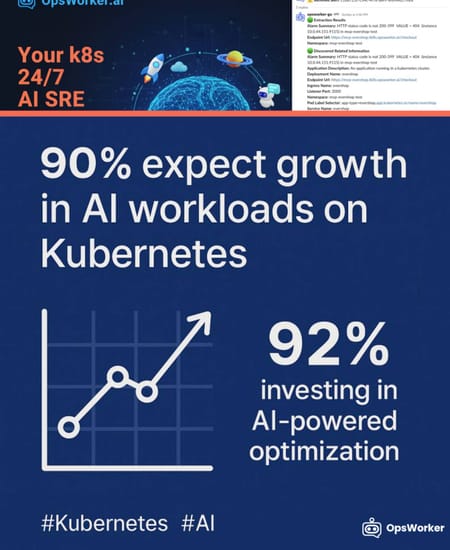
Kubernetes is no longer just for microservices—it’s quickly becoming the backbone for AI/ML. With 92% of teams investing in AI-powered optimization, the challenge shifts to 🔎 observability, ⚡ efficiency, and 💸 cost control. A recent Cloud Native Computing Foundation (CNCF) + community survey shows that nearly every enterprise running Kubernetes expects an increase in AI/ML workloads — and 92% are actively investing in AI-powered optimization for their clusters. That’s a clear signal: Kubernetes isn’t just for microservices anymore; it’s becoming the backbone of modern AI infrastructure. But with this growth comes new challenges: scaling GPU nodes efficiently, managing cost spikes, and ensuring observability across AI-driven pipelines.
At opsworker.ai , we see the same trend every week with teams we talk to. As AI expands in production, incidents won’t just come from app code—they’ll emerge from ML workloads stressing infra in unexpected ways. That’s where autonomous, agentic troubleshooting helps: proactively detecting bottlenecks, optimizing resources, and keeping operations resilient while engineers focus on innovation.
Subscribe to our email newsletter and unlock access to members-only content and exclusive updates.
Comments