
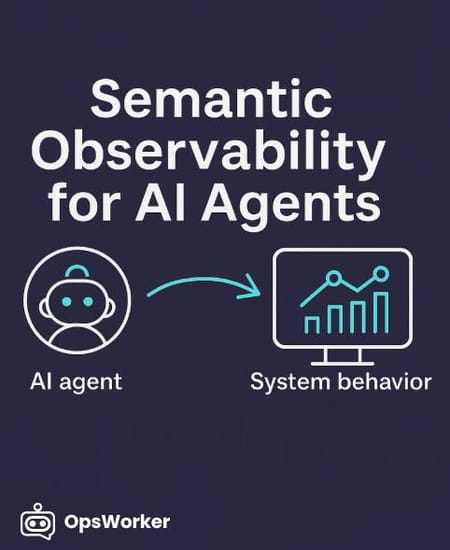
In a future where AI agents act on your infrastructure, observing just logs or traces won’t cut it — you need to see both why and what at once.
AgentSight (Aug 2025) introduces a hybrid observability approach that marries high‑level agent intent (prompts, reasoning) with low‑level system behavior (kernel events) using eBPF and TLS tapping. arXiv Traditional toolsets show “the agent asked X” or “a process executed Y” — but not how those map to each other. With AgentSight, you can detect reasoning loops, spot prompt injection attempts, trace across agent boundaries, and debug coordination failures in multi‑agent systems. For platform engineering and SRE teams building agentic stacks on Kubernetes, this is a foundational leap: you can no longer treat agents as black boxes — you must instrument across the semantic boundary.
This maps closely to how we think about observability at OpsWorker.ai. Our investigation work today already lives at a version of this boundary - correlating what changed (deployments, config, code) with what broke (logs, events, runtime state) to produce a root cause an engineer can trust. As more of what runs in a cluster is itself an agent rather than a traditional service, that same correlation - intent on one side, system effect on the other - becomes the thing worth investigating.
AgentSight's boundary tracing is a genuinely useful building block for that: eBPF-based, framework-agnostic, and it doesn't require instrumenting the agent itself - which matters, because agent frameworks change fast and anything requiring code changes inside them will be perpetually out of date. The transparency it offers is exactly the kind that turns agents from mystery boxes into something a team can actually reason about when one misbehaves.
Subscribe to our email newsletter and unlock access to members-only content and exclusive updates.
Comments