
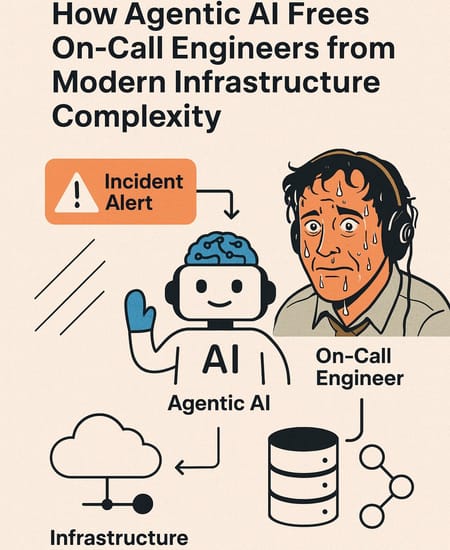
Modern distributed systems are powerful, but they’ve made the on-call life harder. Engineers face rising alert volumes, fragmented observability data, and the burden of tribal knowledge. The complexity of managing systems like Kubernetes, service meshes like Istio, Envoy, Cloud services such as AWS RDS, API Gateway, and Lambdas often add to this strain, especially when architectures must align with security policies, compliance requirements, and auditability. Despite cloud-native stacks, root cause analysis still takes hours, with engineers piecing together logs, dashboards, and past tickets manually. The rise of Large Language Models (LLMs) has opened a door: AI OpsWorker that reasons, plans, correlates, and operates like a real teammate, at scale.
On the other hand, companies today face a critical shortage of skilled SRE, DevOps, Cloud, and Platform engineers, leading to significant operational inefficiencies. Existing engineers are overburdened, with DevOps professionals spending up to 70% of their time on routine maintenance, support, and provisioning tasks—activities that are repetitive and ripe for automation. Simultaneously, software engineers are diverted from their core development responsibilities, allocating 10-20% of their time to infrastructure and platform-related issues. This misallocation of resources results in increased operational costs, project delays, and stifled innovation. The industry urgently needs a solution to automate these routine tasks, alleviate the talent shortage, and enable engineers to focus on strategic, high-value work that drives business growth.
This shift isn’t just about productivity—it’s becoming critical to operational survival in complex cloud-native environments
Agentic AI Explained
Definition: Agentic AI refers to a system that can autonomously reason, plan multi-step actions, invoke external tools or APIs, and adapt its strategy based on evolving context and memory. It leverages LLMs not just for language output, but as a reasoning engine paired with tool-use capability.
Key attributes: For technical audiences, Agentic AI systems are characterized by chain-of-thought reasoning pipelines, modular tool invocation layers (e.g., API clients, kubectl operators), persistent scratchpad memory for intermediate results, context enrichment from multiple sources (logs, metrics, traces), and multi-turn orchestration logic.
Contrast with traditional AI assistants: Traditional AI assistants or chatbots provide stateless, single-shot responses based on surface-level prompt+response paradigms. Agentic AI systems in Kubernetes and cloud-native environments instead coordinate complex, multi-system workflows where resolving a single service issue (e.g., API downtime) often requires reasoning across heterogeneous data sources (Prometheus metrics, Kubernetes pod states, Istio traffic rules, RDS or DynamoDB health) and executing sequences of diagnostic or corrective actions.
Examples:
- Can determine the root cause of pod failure by correlating logs, rollout history, and traffic spikes
- Can find which dependent service in multi-dependent microservices degraterd
Agentic AI Architectures for on-call Engineers and the complexity behind it
Let’s start with a seemingly simple incident: an on-call engineer receives an alert — say, the checkout page is timing out. On the surface, it’s just another service degradation.
Today’s LLMs, dashboards, and alerting systems can help answer basic questions: “What endpoint is failing?”, “What’s the HTTP code?”, or even “Is the pod up?” These tools work — as long as the ecosystem is clean, consistent, and well-labeled.
But real-world production systems are rarely that tidy.
What happens when:
- Are labels inconsistent or missing entirely?
- Tribal knowledge exists only in one senior engineer’s head or is buried in old Slack threads?
- Dependencies span across services, databases, and meshes that no one has touched for months?
At that point, the investigation stops being a data query and becomes a reasoning challenge.
To accurately trace the failure path — from a degraded endpoint back through Istio routes, Kubernetes services, misconfigured deployments, and deep into a legacy Postgres instance — we need multi-hop reasoning across noisy, fragmented telemetry and config. We need to infer connections that aren’t explicitly declared. And we need to do that without hallucination, under pressure, with context from both the system’s current state and its history.
This is where most traditional assistants break down — and where Agentic AI becomes essential.
In contrast, most AIOps platforms rely on fixed correlation rules or basic anomaly detection, which often miss edge cases that require deep context interpretation and domain reasoning
It’s not just about summarizing metrics. It’s about composing a hypothesis, validating it with facts, pivoting when needed, and drawing conclusions that operators trust. And to do that well, the system must combine structured retrieval, procedural logic, and step-by-step tool use — not just large language generation.
Building such pipelines is hard. Generalizing them for diverse architectures — across cloud providers, teams, tooling stacks, and compliance boundaries — is even harder.
But solving this complexity is exactly what the next generation of operational intelligence must do.
📌 Why It Matters for Your Business
........................................................................
Core Technical Benefits & Quantified Impact
Let’s explore how OpsWorker’s Agentic SRE CoWorker addresses critical pain points by improving key KPIs, automating complex processes, and reducing operational overhead — ultimately delivering measurable value through faster incident resolution, higher system reliability, and greater engineering productivity.
- Incident-related KPIs: Reduced MTTR, consistent diagnostics, reduced alert fatigue
- Proactive prevention: Prevention of infrastructure-related issues at early Software development stages (e.g., correct provisioning, deployment, and architecture guidance during development)
- Human-related factors: knowledge retention, reduced cognitive load on Engineering teams, reduced communication burden & efforts for round-the-clock Q&A between Software development and SRE/Platform team, and removing infrastructure burdens from Engineering teams(maintenance, change-management, performance, security, and other improvements)
Let's make a Hypothetical, still based on real-life experience, value calculation for a company with 300 technical staff:
Engineers lose 📉
- Engineers lose ~2% of time annually to minor to critical incident handling (avg. 40 hours/year)
- Engineers lose ~8% of time annually to infra-related distractions (e.g., correctly setting up infra components, debugging config, dealing with maintenance, updates, change management, and pipelines) (avg. 160 hours/year)
- Engineers lose ~2% of time annually on communication and keeping themselves up-to-date for infrastructure-related matters (avg. 40 hours/year)
- Average cost per engineer: $75/hour → $18,000/year lost per engineer
300 engineers → $5,400,000 total loss/year
If OpsWorker saves just 40% of the Engineers' loss, it would be → $2.16M value recovered annually
Incident-related reduction of MTTR: 📉
According to New Relic’s State of Observability 2024 report, companies experience a median of 77 hours of downtime annually, with organizations reporting up to ~183 outages per year depending on observability maturity (New Relic 2024).
Assuming a typical 30 hours of total annual downtime (≈ 99.657 % availability) for a mid-sized company, and that OpsWorker reduces incident recovery time by 40 %, this would mean roughly 12 hours of downtime saved per year.
Cost savings:
The average cost of downtime was estimated at $5,600 per minute in a 2014 Gartner study (Atlassian summary), equivalent to about $336 k per hour.
A later Ponemon Institute report (Cost of Data Center Outages 2016, Vertiv study) raised that figure to nearly $9,000 per minute (Ponemon 2016 PDF).
These ranges were further confirmed by Statista (2020), showing hourly downtime costs frequently exceeding $300 k (Statista 2020).
Using the conservative Gartner number ($5,600 /min):
12 hours × $336 000 = ≈ $4.0 million annual savings
Summary: Estimated Annual Impact for 300-Engineer Company
Category: Engineers lose: time saved from infra distractions, reduced communication, minor to critical incident handling
Estimated Annual Cost Saved: $2.16M
Basis: 40% OpsWorker saves from the total 12% time Software development and other Engineers lost on infra-related work
Category: Incident MTTR reduction (50%)
Estimated Annual Cost Saved: $4.03M
Basis: 12 hrs faster × $336K/hr cost of downtime
Total Estimated Value = ~$6.19M/year - OpsWorker impact on productivity & availability
So, OpsWorker’s impact translates at least into $6 million in savings, on top of the productivity boost from reduced developer effort and less reputation impact on the organisation due to service degradation. Additionally, this enables companies to scale operations without linearly increasing platform headcount.
Let's put it all together:
Conclusion
OpsWorker represents a step-change in how modern engineering teams can manage the operational complexity of distributed systems. Through its agentic architecture, it enables reliable, auditable, and efficient incident diagnostics and automation. By offloading the cognitive load of correlation, investigation, and remediation, OpsWorker empowers software and platform engineers to focus on innovation and value delivery — all while materially improving system reliability, reducing downtime, and containing operational costs. OpsWorker isn’t replacing engineers — it’s giving them back time, trust, and technical clarity when they need it most.
Subscribe to our email newsletter and unlock access to members-only content and exclusive updates.
Comments