
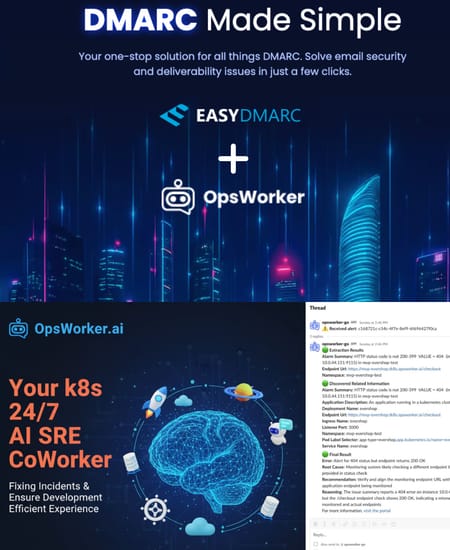
Last week marked a significant milestone for OpsWorker.ai — our AI-powered SRE Agent — as we entered a real-world Kubernetes environment with our first design partner, EasyDMARC.
After just one week in production, OpsWorker has autonomously handled 18 live incident investigations, giving us not only critical technical validation but also invaluable feedback from real DevOps and engineering teams working in production systems.
This early rollout moves us beyond demos and controlled tests. For the first time, OpsWorker is operating where real failures happen, where telemetry is messy, configurations vary, and the edge cases are everywhere. In short, it's doing AI SRE in the wild
What is OpsWorker.ai?
OpsWorker.ai is an Agentic AI platform designed to function as a 24/7 AI SRE Agent — a virtual co-worker embedded into your cloud-native stack. It goes beyond passive dashboards and simple copilot prompts.
Instead, OpsWorker:
- Ingests alerts from your observability tools (e.g., Prometheus, Blackbox, Alertmanager)
- Correlates signals across Kubernetes, cloud infrastructure, and deployment metadata
- Builds context-aware investigations to uncover the root cause
- Delivers remediation guidance inside Slack or your incident tooling
Unlike traditional AI Ops or chat-based AI DevOps assistants, OpsWorker performs multi-step reasoning, traces dependency chains across services, and applies real-time logic to suggest (and eventually execute) next steps — all without human prompting.
It’s not a chatbot. It’s a co-worker that happens to be made of code.
Week One in Production: Raw Numbers, Real Feedback
Here’s what happened in the first 7 days of real-world deployment at EasyDMARC:
- 18 investigations automatically triggered by live alerts
- ✅ 10 marked as successful by engineers (investigation quality, correct analysis, or direction)
- ❌ 8 marked as failed
- ⚠️ 7 of those due to discovery limitations (missing metadata, incomplete source mapping)
At face value, a 40% success rate might seem modest. But in the context of agentic AI operating autonomously in a live, noisy production environment, it’s a huge leap.
Each failure wasn't just noise — it was a signal. It showed where our discovery logic needed to improve, where assumptions broke, and where Kubernetes configurations in the wild didn’t match our training environment.
The feedback loop is already paying off. We’ve started shipping fixes and improvements based on these exact cases. And as the agent observes more environments and integrates deeper into varied setups, it will only get better.
Why Traditional AI Ops Tools Fall Short
Most AI Ops solutions today focus on anomaly detection or alert deduplication. While helpful, they don't solve the hard part: What do I do next? And how do I get there quickly?
Traditional AI DevOps tools are often built around reactive Q&A models or rigid playbooks. They don’t handle edge cases well. They don’t reason about context. They don’t adapt.
OpsWorker.ai was built to do just that:
- It understands alert context (not just the label, but what it actually means in your system)
- It navigates Kubernetes abstractions (services, ingresses, deployments, nodes)
- It traces dependencies, checks health across components, and examines recent code or infra changes
- It’s built with agentic reasoning — planning multi-step actions instead of single-response answers
This is the difference between a co-pilot and a co-worker.
Business Value: What This Means for Engineering Teams
The vision behind OpsWorker is simple:
Minimize MTTR, maximize engineering velocity.
In practice, that means:
- On-call engineers get answers faster, without jumping between 5 dashboards and
kubectl - Less time is wasted on repetitive diagnostics — freeing teams to focus on higher-value engineering
- New team members ramp up faster, because the AI shares investigation context clearly
- Platform and SRE teams scale better, without needing to grow headcount linearly with system complexity
And from a leadership perspective:
- Fewer escalations, fewer burned-out engineers, and more predictable operations
- Clear ROI from reduced incident handling time and smoother development cycles
- A foundation for continuous improvement, as OpsWorker learns from every investigation
What We’re Learning — and What’s Next
These 18 investigations represent a real-world training set — not for fine-tuning language models, but for improving reasoning pipelines, discovery logic, and action planning.
We’re actively expanding OpsWorker’s:
- Ingress and service discovery coverage, to handle more routing edge cases
- Dependency graph mapping, even in unlabeled or loosely coupled environments
- Integration surface, including deeper cloud event correlation and deployment metadata parsing
- Knowledge integration, to embed tribal knowledge into every investigation
We're also exploring safe execution capabilities — so OpsWorker can not only suggest remediation, but test and perform it (with guardrails in place).
Join the Early Journey
We’re grateful to our early design partners for trusting us while the product is still raw. It’s the kind of partnership that leads to real breakthroughs — not just polished demos.
If you're running Kubernetes in production and feel the pain of incident fatigue, slow MTTR, or overloaded SRE teams, we’d love to talk.
You can follow along, partner with us, or even help shape how the next generation of AI SRE Agents will work.
OpsWorker.ai is still a baby. But it's real. It's running. And it's learning — fast.
Subscribe to our email newsletter and unlock access to members-only content and exclusive updates.
Comments